
Simple Tennis Drills to Improve Consistency
Consistency is the foundation of reliable tennis. If you can repeatedly put balls back in play with good depth, direction and timing, you win more points, reduce unforced errors and build the confidence to play aggressively when it matters.
This guide collects straightforward on-court and off-court drills you can do alone, with a partner, or in small groups. Each drill targets a specific element of consistency — rhythm, footwork, timing, reaction and recovery — and includes simple progressions so you get measurable improvement without complicated setups.
Why consistency matters
Consistency reduces variance in your game. Instead of thinking only about winners, think about how often you can keep the ball in play with a target in mind. Consistent players force opponents into risk-taking, control rallies, and can choose the right moment to change pace or direction.
Training for consistency focuses on repetition with quality: a steady tempo, proper footwork, and technique that’s repeatable under pressure. The drills below are selected to build those habits efficiently.
Warm-up and rhythm drills
Start every session with dynamic movement and ball-feel work. Jump rope sequences set the heart rate and improve timing before you touch the racquet. Use short intervals — 30 seconds on, 15 seconds rest — then move to low-intensity hitting.
Try this warm-up progression: 1) 2 minutes continuous jump-rope footwork, 2) shadow swings focusing on contact point, 3) 10 slow feed forehands and backhands alternating sides. For reliable conditioning and foot cadence, a dedicated Jump Ropes for Tennis Conditioning product helps keep rhythm consistent during practice.
Footwork and balance
Most inconsistent shots come from poor preparation. Drill your split-step, side shuffle, and recovery with short-court movement patterns. One effective drill: set two cones 6–8 feet apart parallel to the net. Feed short crosscourt balls; on each return, move to your recovery cone before the next feed. Focus on small, controlled steps and resetting your base.
To improve single-leg stability and balance through the hitting zone, include balance board sessions twice a week. Controlled instability trains the ankle, knee and hip chains to adjust quickly without overcompensating. A reliable option is the Balance Boards for Tennis category for tools designed specifically for court athletes.
Solo practice: rebounder and control work
Solo drills are invaluable for repetition and internal focus. A rebounder lets you practice hundreds of controlled exchanges in a short time and forces consistent contact and foot adjustment. Use these solo progressions: 1) two-handed volley feeds to chest height for 1–2 minutes, 2) forehand-only continuous feeds focusing on one spot, 3) alternating deep and short feeds to practice depth control.
Portable solo trainers are easy to set up and let you isolate stroke mechanics and timing without a partner. A well-made option like the Hikeen Premium Tennis Trainer Rebound provides predictable ball return and consistent reps for building reliable contact patterns.
Rally and target drills
Partner drills that emphasize targets and rally length teach control under simple pressure. Use cones or towels as deep and short targets — rally until one player misses the target five times, then swap roles. Gradually increase rally length: start at 6–8 shots and progress to 15–20 shots while maintaining the target.
For juniors or players working on reduced rebound and slower pace to emphasize placement, softer and lower-compression balls help you develop consistent contact and tracking. Using Junior Tennis Balls can slow play enough to refine timing and encourage cleaner strokes during target work.
Reaction and anticipation drills
Consistency isn’t just technical — it’s also about reacting correctly to what your opponent does. Incorporate short, high-frequency reaction drills that force split-second decision-making: coach or partner calls a direction at the last moment while you perform a split-step and accelerate to the ball.
Tools that flash, beep, or require quick hand-eye responses help accelerate reflexes and reduce hesitation. For structured reaction training use equipment from the Reaction Training Equipment category to simulate unpredictable ball paths and sharpen anticipatory movement.
Core and stroke stability
A stable core allows energy transfer from the ground through the body into the racquet with minimal leakage. Core stability reduces variability in swing path and contact point, improving repeatable accuracy. Integrate short core sets three times weekly: plank variations, anti-rotation holds, and controlled rollouts.
Training tools that isolate rotational control and anti-flexion strength make these sets more efficient. Consider specific devices from the Core Training Equipment category to build the exact motor patterns your strokes need.
Strength training and conditioning
Strength work focused on the upper body, shoulders and posterior chain helps you maintain relaxed power and consistent racquet acceleration deep into long matches. For on-court mimicry, include resisted swings and banded warm-ups to groove shoulder and scapular patterns.
Light-resistance bands build endurance for repeated swings and can be used for hundreds of low-load reps to develop consistent contact mechanics. Explore Strength Training Bands designed for sport-specific movement. Combine this with timed conditioning sets using Jump Ropes for Tennis Conditioning to maintain foot speed and recovery between points.
Recovery and maintenance
Consistency issues often stem from fatigue and niggles. Regular recovery preserves movement quality and repetition fidelity. Post-session routines should include soft tissue work, mobility, and targeted percussion to speed muscle reset.
Percussion devices aid rapid recovery for tennis-specific muscle groups. A quality device from the Massage Guns for Tennis Recovery category can reduce soreness, limit stiffness, and help maintain consistent mechanics in back-to-back practices.
Simple checklist
- Warm up 8–10 minutes with jump rope and shadow swings
- Do balance/footwork drills 2–3 times per week
- Include solo rebound sessions for high-rep contact
- Practice target rallies: increase rally length gradually
- Train reaction drills 2 times per week
- Perform core stability sets and banded swing endurance
- Use recovery tools after high-volume sessions
FAQ
Q: How often should I practice these drills to see improvement?
A: Aim for quality over quantity. Three focused sessions per week with one solo high-rep session, one partner/rally session, and one movement/conditioning session will show measurable gains in 6–8 weeks.
Q: Can beginners use these drills?
A: Yes. Start with reduced intensity, shorter rally goals, and lower-compression balls for easier contact. Progress by increasing tempo and target difficulty as control improves.
Q: How do I track consistency improvements?
A: Use simple metrics: rally length (average shots per rally), target hit rate (percentage of successful target shots), and unforced errors per set. Record sessions and measure weekly trends.
Q: Should I prioritize technique or repetition?
A: Both. Begin with technique-focused low-speed reps to ingrain correct patterns, then add higher-repetition drills to build consistency under fatigue.
Q: When should I add strength or recovery tools?
A: Introduce bands and core work once basic movement patterns are consistent. Add recovery tools immediately after sessions where volume or intensity is above usual levels to protect movement quality.
Conclusion — practical takeaway
Consistency is built through purposeful repetition, reliable movement patterns and proper recovery. Structure your week with targeted drills (rhythm, balance, solo reps, reaction, core and strength) and use the right tools to make each rep count. Small, measured progress each week compounds into dependable performance on match day.
Products Featured in This Article
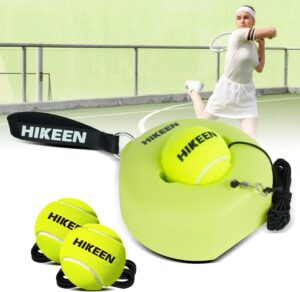
Hikeen Premium Tennis Trainer Rebou…
Hikeen Premium Tennis Trainer Rebound with Metal Base [DURABLE METAL BASE]:Hikeen tennis trainer rebound upgraded with…
